Most people think of Cannas as being just a flower... wrong! Canna is an agricultural plant that has been recruited into floriculture. No vegetable gardener worth his salt would ever dream of growing a crop of root vegetables, which is what Canna is, in the same ground for a second year, a good farmer or gardener rotates his crops.
Monoculture, the continual growing of a single crop on the same ground, supported completely by chemicals has become questioned in recent years. It is true that vineyards, and orchards are examples of successful monoculture, but plants as greedy as Canna do not fall into the same category.
Crop rotation or crop sequencing is the practice of growing a series of dissimilar types of crops in the same space in sequential seasons for various benefits such as to avoid the build up of pathogens and pests that often occurs when one species is continuously cropped. Crop rotation also seeks to balance the fertility demands of various crops to avoid excessive depletion of soil nutrients. Crop rotation can also improve soil structure and fertility by alternating deep-rooted and shallow-rooted plants.
 A low nitrogen level will leave Canna foliage with yellow striata, and slow its growth rate. Phosphurus helps with the transformation of solar energy into chemical energy; proper plant maturation; withstanding stress. Potassium helps in the building of protein, photosynthesis that keeps the foliage a consistent green, and reduction of diseases. As can be deduced from that, deficiencies in theses basic macronutrients can result in unhealthy plants with effects that can be mistaken for Canna virus. Those are only the three primary nutrients required for healthy plant growth, and many others are required in sufficient quantities to provide healthy, vigorous growing conditions.
Crop rotation is also used to control pests and diseases that can become established in the soil over time. Plants within the same taxonomic family tend to have similar pests and pathogens. By regularly changing the planting location, the pest cycles can be broken or limited.
Cannas grow remarkably quickly, and to do that they require great supplies of both nutrients and minerals. A good canna crop means that the soil is now stripped of most food and minerals. It needs a way of being replenished. Of course, in a small garden, you can swap Cannas from one bed to another, or even swap the soil between the beds, enriching it at the same time. Farmyard manures is the traditional preferred choice, but for those who do not access to that, then there are many safe packaged alternatives.
When making a fertilizer selection, remember that it is not only nutrients, mainly the big three of nitrogen, phosphorus, and potassium, but also the neglected calcium, magnesium and sulfur, and also the trace elements that are necessary in minute quantities for the proper growth, development, and physiology of the Canna, i.e. iron, manganese, boron, copper, molybdenum, nickel, chlorine, and zinc.
In fact, there are 72+ biological trace elements in all, and many people are concerned about the historic agricultural focus on the big three elements, as over time, their residues turn into salt and eventually make the soil sterile and un-arable. Millions of acres in North America and elsewhere have already become too salty to grow anything. It is a huge problem, compounded by damaging 'fertilizer runoff' into our rivers and water tables. Such a 'complete spectrum', 72+ trace element fertilizer can be easily obtained from seawater, since the seas contain all of the 92 elements of the Earth in suspension. Fertilizers based on seaweed are particularly efficient at restoring many of the missing, ignored trace elements.

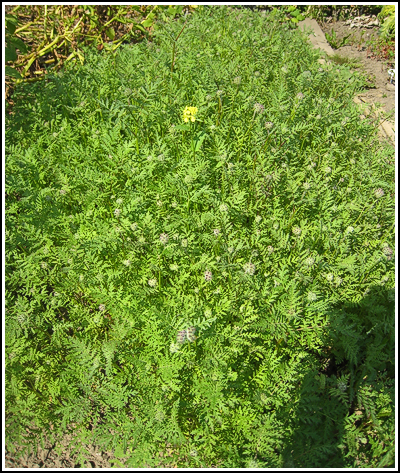
A green manure, ready for ploughing into the soil, about 3 weeks before planting with Cannas
Also, in the northern climates, one method of assisting is to take advantage of the 5-6 winter months when Cannas are safely indoors and the land lays fallow, just growing some tough old weeds. The technique is to grow a green manure crop over winter, which can be ploughed back into the ground come the following spring. This enriches the soil, interrupts the pest cycle, with the added benefit of suppressing weeds over the winter months. Combine that with mulching over the Canna growing season and you can be on your way to providing perfect conditions for growing perfect Cannas.
After thought:
Linus Pauling, winner of 2 Nobel prizes, stated: "You can trace every sickness, disease or ailment in the human body to a mineral (trace element) deficiency." Surely, that applies to our Cannas as well?