Showing posts with label Yellow King Humbert. Show all posts

Friday, 6 August 2010

Canna 'Red King Humbert'


A medium sized Italian Group cultivar; bronze foliage, oval shaped, maroon margin, branching habit; triangular stems, coloured purple; spikes of flowers are cupped, self-coloured red, staminodes are large, edges lightly frilled, petals purple with farina, fully self-cleaning; seed is sterile, pollen is sterile; rhizomes are thick, up to 3 cm in diameter, coloured purple; tillering is average.
This is Canna 'Yellow King Humbert' that has reverted back to an all-red state, having originated as Canna 'Roi Humbert 1'. After the shake-up of two mutations it is not safe to refer to it as C. 'Roi Humbert 1', as the genetic make-up has been affected through two major mutations, hence the new name.
Probable synonyms: C. 'Out of Africa', C. 'Ty Ty Red'

Thursday, 8 April 2010

Most mutations occur during summer months

In biology, mutations are changes to the base pair sequence of the genetic material of a plant. Mutations don't just happen by themselves. The likely stimulants can be caused by copying errors in the genetic material during cell division, by exposure to ultraviolet or ionizing radiation, chemical mutagens, or viruses, or can occur deliberately under the plants own cellular control during processes such as hypermutation.


In 1976, K. P. George and G. G. Nayar of the Bio-Medical Group, Bhabha Atomic Research Centre, Trombay, Bombay-40085, India published a paper in which they described how the frequency of spontaneously occurring mutations were recorded in the Canna var. ‘Yellow King Humbert’. The studies have indicated that the mutation rate was high from January to April (the Indian summer) and low from July to September (the Indian winter). Among the floral parts, petals showed the highest mutation rate followed by sepals and staminodes. The size of the mutant sector also varied according to the stage at which the mutations occurred.

Tuesday, 15 December 2009

You couldn’t invent it!

Just read an article on the TyTy web site, and after I had finished laughing, I decided that I had to share it with you. The article is titled “Review of Victorian Canna Hybrids”. It has a rare distinction, in that every 'fact' quoted in the article is incorrect! It is not often that you encounter a 100% incorrect article.
The article ignores the fact that Carl Sprenger in Italy introduced the first C. flaccida x C. “Madame Crozy” cultivars and lays their introduction on Luther Burbank, who actually introduced his own cultivars some two years later.
The article then goes on to confuse Burbank’s own cultivars, whose writings and published photographs show and describe C. ‘Tarrytown’ as being a large red flowered cultivar and C. ‘Burbank’ was yellow with some red spots in the throat. Up until then I was merely amused at the ignorance being attested to as fact.

At Claines Canna we are growing both C. ‘Tarrytown’ and C’ ‘Burbank’, and they comply with Luther Burbank’s own descriptions and are Italian Group cultivars, see photo from Burbank's book, above. They arrived here from unimpeachable collector sources.
Where I started to laugh was when the article asserted that Messrs J.C. Vaughan, the distinguished Chicago seeds men then renamed C. “Tarrytown” to C. “Florence Vaughan”, and at the same time the article transformed the cultivar into being “lemon yellow with creamy-orange splotches and dots”. All the contemporary reports and Vaughan’s own adverts from the 1890's show C. “Florence Vaughan” to be a Crozy Group flower, yellow with red spots, a fully attested specimen is still grown in Australia, see below right. This total made-up version of history is quite remarkable and amusing, but there is the danger that the uninformed will take it seriously.


A study of contemporary literature would clearly show that the lemon yellow with creamy-orange splotches and blobs being referred to is C. ‘Roma’, introduced by Carl Sprenger in 1897, above left. References include Revue Horticole in France, Garden and Forest in USA, and the Royal Horticultural Society Yearbook in England. The ultimate authorities of the time, and there are many more references from unimpeachable sources, versus this silliness on the TyTy web site!
The article also goes on to assert that the Italian Royal family, King Emmanuel II and his son, King Humbert were Canna hybridisers! There is not a shred of evidence to confirm this silliness.
Also, an English gardener, presumably hinting at the award winning gardening author Ian Cooke, renamed C. ‘Yellow King Humbert’ as C. ‘Richard Wallace’. C. 'Richard Wallace' is a Crozy Group cultivar introduced by Wilhelm Pfitzer in 1906, and what is now being sold under that name is C. ‘Austria’, a totally different style, an Italian Group cultivar. It is a confirmed fact that C. ‘Yellow King Humbert’ is a mutation of C. ‘King Humbert’ (‘Roi Humbert’), and it has been sold under that name since the 1920’s. It is only since the early 1980’s that there has been confusion over that one, also, C. 'Cleopatra', which first appeared in the 1960's is also a synonym of C. 'Yellow King Humbert'.
It is obvious that whoever wrote this article is very ill-informed! My suggestion would be that they take an elementary course in Canna flower types, when they would understand that there is more to Canna flowers than their colours.
There is an article on the Wikipedia that attempts to explain the various Canna types in a fully attested manner. Wikipedia does not allow statements or assertions without supporting references. See wikipedia.
Anybody wanting to see the subject of this article for themselves can view the link at:

Wednesday, 7 October 2009

Canna 'Ambassador'


A medium sized Italian Group cultivar; dark foliage, oval shaped, maroon margin, branching habit; oval stems, coloured purple; panicles of flowers are cupped, self-coloured scarlet, staminodes are large, edges lightly frilled, petals purple with farina, fully self-cleaning, good bloomer; seed is sterile, pollen is sterile; rhizomes are thick, up to 3 cm in diameter, coloured purple; tillering is average.


Probably a mutation of the old chimera, C. 'Yellow King Humbert'. Synonyms: C. 'Ambassadeur', C. 'Ambassador Red', C. 'The Amabassador'

Friday, 2 January 2009

Earliest evidence of Yellow King Humbert

Kent Kelly, a leading US Canna authority, has located documents published on Google Book Search that show the earliest evidence revealed to date about Canna 'Yellow King Humbert'. It is from "The Garden Magazine ", May 1918, and is an advert by the Vaughan Seed Co., Chicago, IL. USA.

We know that it was a sport of Canna 'Roi Humbert' aka 'King Humbert', confirmed by this advert and the laboratory tests conducted by Dr Khoshoo in India in the 1960's.

Canna 'Roi Humbert' growing at the Nates Parks Department in France, where it has been grown for about 100 years continuously.

Although the Vaughan Seed Co. advert described it as a sport it is much more than that. This is a chimeral mutation, which is the plant-life equivilant of Siamese twins. The DNA of both cultivars is present and at any time can mutate again into the other twin.

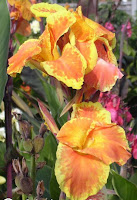
Sometimes the mutations are not complete, as can be seen by the photograph above where just one staminode turned red with tone combinations, and sometimes it is just variegation in the foliage, as in the photograph below.


At other times it mutates totally back and produces a chimera similar to the original C. 'Roi Humbert'. The number of such mutations is legion and they are recorded as sports. They possibly include:
  • Black Knight
  • General Eisenhower
  • Out of Africa
  • Paddy's Red
  • Red Cleopatra
  • Red King Humbert
  • The Ambassadour
  • Ty Ty Red
  • Zulu Masquerade
Many of these sports have subtle differences and are worthy of being treated as separate cultivars.


Canna 'Zulu Masquerade', introduced by Mrs Marcelle Shepard.

Tuesday, 25 November 2008

Revisiting Canna 'Ambassador'


A medium sized Italian Group cultivar; dark foliage, oval shaped, maroon margin, branching habit; oval stems, coloured purple; panicles of flowers are cupped, self-coloured scarlet, staminodes are large, edges lightly frilled, petals purple with farina, fully self-cleaning, good bloomer; seed is sterile, pollen is sterile; rhizomes are thick, up to 3 cm in diameter, coloured purple; tillering is average.

Probably a mutation of the old chimera, C. 'Yellow King Humbert', as it bears a close resemblance to other known mutations, and there is no claim to be an originator from any known source. Synonyms are: C. 'Ambassadeur', C. 'Ambassador Red', C. 'The Amabassador'

Tuesday, 11 December 2007

Most mutations during the summer months

In biology, mutations are changes to the base pair sequence of the genetic material of a plant. Mutations don't just happen by themselves. The likely stimulants can be caused by copying errors in the genetic material during cell division, by exposure to ultraviolet or ionizing radiation, chemical mutagens, or viruses, or can occur deliberately under the plants own cellular control during processes such as hypermutation.

In 1976, K. P. George and G. G. Nayar of the Bio-Medical Group, Bhabha Atomic Research Centre, Trombay, Bombay-40085, India published a paper in which they described how the frequency of spontaneously occurring mutations were recorded in the
Canna var. ‘Yellow King Humbert’, under the synonym of C. ‘Striped Queen’”, over a period of two years. The cultivar is also known under the synonyms of C. ‘Queen of Italy and ’C. ‘Cleopatra’. The studies have indicated that the mutation rate was high from January to April (the Indian summer) and low from July to September (the Indian winter). Among the floral parts, petals showed the highest mutation rate followed by sepals and staminodes. The size of the mutant sector also varied according to the stage at which the mutations occurred.