Showing posts with label Austria. Show all posts

Saturday, 31 October 2009

Canna 'Austria'


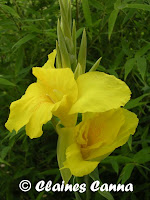
A medium sized aquatic Italian Group cultivar, equally at home as a water marginal or in the border; green foliage, oblong shaped, upright habit; flowers are cupped, self-coloured yellow, throat red spots on yellow, staminodes are large, edges regular, fully self-cleaning, good bloomer; seed is sterile, pollen is low fertile; rhizomes are long and thin, coloured white; tillering is prolific. 

Introduced by C. Sprenger, Dammann and Co., Naples, Italy, EU in 1893. Announced along with C. 'Italia', caused much interest as their large flowers were considered to be a major breakthrough. Herr Sprenger crossed C. 'Madame Crozy' with C. flaccida 'Le Roi'. Synonyms: C. 'Austra', C. 'Canary Bird', C. 'Lemon Zest', C. 'Richard Wallace', C. 'Souvenir de Jeanne'

Monday, 8 June 2009

Revisiting Canna 'Italia'

I just had to share with you this superb illustration taken from the original May 1898 issue of "The Mayflower",a magazine that I had not heard of before, but which had 273,082 subscribers that is "devoted to the cultivation of flowers and plants, fruits, vegetables, and to gardening and home adornment in general."

The illustration clearly shows the colouring and shows that the labellum (lip) is almost all red and has that distinctive notch in its irregular edge.

Other contents include articles and information on "Evolution of the Canna", "Cannas Austria and Italia". All round, this is an informative 111 year old gardening catalog for those interested in the history of Canna.

Friday, 5 December 2008

Hard to store Cannas

Another vintage catalogue arrives, and Dreer's Catalogue of 1937 has an item that I feel I should share, as it is quite interesting.

The catalogue had a boxed feature called "Two Sensational Cannas". It referred to C. 'Mary Thilow' and C. 'Mrs. Pierre S du Pont'.

The boxed item stated that "These two varieties, owing to the fact that the roots are very difficult to store, will be supplied as growing plants only. These will be ready March 1st."

It has been our experience that the most difficult Cannas to store over the winter are the Aquatic Group. This is worse for the F1 aquatic hybrids like C. 'Ra', and C. 'Wye', but also applies to those F2 hybrids like C. 'Burbank', C. 'Austria', and C. 'Roma'.

I have only read about C. 'Mary Thilow', mentioned above, and it would be interesting to hear from anybody else who has any knowledge of that cultivar in recent times. The description in the Deer's catalogue stated that it has "Bronze foliage and brilliant rosy salmon flowers. 4ft (1.3m)."

Tuesday, 2 September 2008

Revisiting Canna 'Austria'


A medium sized aquatic Italian Group cultivar, equally at home as a water marginal or in the border; green foliage, oblong shaped, upright habit; flowers are cupped, self-coloured yellow, throat red spots on yellow, staminodes are large, edges regular, fully self-cleaning, good bloomer; seed is sterile, pollen is low fertile; rhizomes are long and thin, coloured white; tillering is prolific.

Introduced by C. Sprenger, Dammann & Co., Naples, Italy, EU in 1893. Announced along with C. 'Italia', and caused much interest as their large flowers were considered to be a major breakthrough. To achieve this novelty, Herr Sprenger crossed C. 'Madame Crozy' with C. flaccida 'Le Roi'.

Synonyms: C. 'Austra', C. 'Canary Bird', C. 'Lemon Zest', C. 'Richard Wallace', C. 'Souvenir de Jeanne'. The blog yesterday featured C. 'R. Wallace', and examination of the photographs makes one wonder how anyone could ever have confused these two totally different cultivars.

Sunday, 30 March 2008

Carl Ludwig Sprenger

Carl Ludwig Sprenger was a German botanist, born on 30 November 1846 at Güstrow, Mecklembourg and died 13 December 1917 on the island of Corfu.

Canna (Italian Group) 'Austria', Sprenger 1893

Sprenger lived in Naples from 1877 to 1917, and was a partner in the horticultural house of Dammann & Co. of San Giovanni a Teduccio, Naples, Italy. David Fairchild praised Sprenger, "a brilliant botanist who had established a nursery...he was one of those real plantsmen who both know the names of plants and how to grow them. Sprenger was known to roam mountain sides and meadows. He enthusiastically collected seeds for botanical gardens and freely gave of his knowledge to others.

The eruption of Vesuvius [April 4, 1906] buried his plants under volcanic ash, destroying hundreds of his best specimens." Sprengers' life was in ruins.

In 1907, Kaiser Wilhelm (William II) purchased Achilleion, a garden with a palace on Corfu (Kerkyra). Sprenger became supervisor of the Kaiser's garden.

Sprenger's life had had no sound; Fairchild wrote that he was "very deaf". Perhaps he loved plants so much because they spoke in colours, shapes, and scents. In the end, he did not even have flowers. The man who surrounded himself with plants died December 13, 1917, a hostage of war. Being German and living on a Greek island in the middle of the First World War was high-risk, but at 70 years of age he was not prepared to leave behind his beloved plants and move to another country. Nobody was able to establish what really happened, but it is hard to see what threat a 71 year old, deaf, botanist posed that justified his murder.


Canna (Italian Group) 'Italia', Sprenger 1893

Sprenger had concluded that by constantly interbreeding the large flowered Crozy varieties nothing novel or more remarkable could be secured, and he, therefore, experimented with some new blood, employing for this purpose the Canna flaccida, a species of the southern USA, of medium height and large flowers, with one specially developed petal. The result was what became known as the 'Orchid' Cannas or the 'Italian' Cannas. A few years later, Luther Burbank in the USA pursued a similar approach.

  • 1893, Canna 'Italia' and Canna 'Austria'
  • 1894, Canna 'Atalanta', Canna 'America', Canna 'Burgundia' and Canna 'Allemaniana'
  • 1895, Canna 'Bavaria', Canna 'Britannia' , Canna 'Heinrich Seidel'
  • 1896, Canna 'Pandora'
  • 1897, Canna 'Edouard André', Canna 'Parthénopé' and Canna 'Roma'
  • 1907, Canna 'Wilhelm Bofinger', Canna 'Pluto'
  • 1909, Canna 'Roi Humbert'

Sprenger also created and named 122 beautiful Yucca hybrids in the years from 1897 to 1907.

Saturday, 22 March 2008

Canna 'King Midas' in Crozy Group


The 1939 catalogue released by the Inter-State Nurseries of Hamburg, Iowa, USA. has some interesting information. The catalogue features 9 Cannas that year, including Canna 'King Midas''. Inter-State Nurseries were America's largest direct-to-you nurseries, or so they claimed in the catalogue.

The Cannas offered for sale were: Canna 'Apricot', C. 'Eureka', C. 'Hungaria', C. 'King Midas', C. 'Mme. Crozy', C. 'President', C. 'Statue of Liberty', C. 'Wintzer's Colossal', and C. 'Yellow King Humbert'.

What is immediately apparent from the photograph is that this is not an Italian Group cultivar, see how the labellum (lip) is smaller than the staminodes. The stamen is normal sized, and not as large as the Italian Group varieties. Also, there are no red spots in the throat. The whole red stamen and style are also unmistakeable. We, at Claines Canna, have a cultivar we imported from Turkey that is identical to this, and is called C. 'King of Gold'. That name is translated directly from the Turkish, and I believe means that we have the original C. 'King Midas'.

I have long suspected that what is currently being sold as Canna 'King Midas' was incorrectly named and it is pleasing to find such evidence. I can see no difference between the misnamed Italian Group specimen and Canna 'Austria', and it looks like another misnaming from the early 1980's in the USA.

In Greek mythology,
Midas or King Midas (in Greek Μίδας) is popularly remembered for his ability to turn everything he touched into gold: the Midas touch. The picture above emphasizes the golden colour and it is obvious that if it had been a paler yellow, like the current misnamed Italian Group specimen, it would not have been given this name.

Tuesday, 8 January 2008

Stars of the Day: The Yellow Italian-types 'Austria', 'Asia' and 'Burbank'.

In 1895 when Carl Sprenger of Dammon & Co., in Naples, Italy, distributed his radically different "orchid flowered" cannas with Canna flaccida in their ancestry, they startled the gardening world. Never before had such huge Canna blooms been seen. They were bred for use in glassed conservatories and never claimed to be excellent open bedding plants.


The modification of anthers into what resembled extra staminodes (those showy parts of a Canna flower that look like petals), created the illusion of a semi-double flower. In fact the old nurserymen describe them in their catalogues as outer petals being such and such a colour and the inner petals (the modified anthers) being of another colour or pattern of colouration. They likened them to large orchids - hence the early epithet. Today they are better described as "Italian-type" cultivars even though the dark foliaged, orange flowered 'Wyoming' and the green foliaged, yellow flowered 'Burbank' we know were bred in the USA by Luther Burbank. He may have bred a few of other red ones that as yet are unidentified, as a couple of good reds were illustrated in his booklet The Canna and the Calla: and some interesting work with striking results. The Italian-type cannas do not set seed and their pollen is only moderately fertile due to different chromosome numbers between the initial cross of C. flaccida with the Crozy-type 'Madame Crozy'. This, plus their modified anthers that resemble extra "petals" distinguishes them from the seed setting Crozy-types.


One of the complaints in the gardening press in the late 19th century was that many of these new cannas were very similar and it was difficult to distinguish between some of them. If it was difficult for gardeners involved in all the excitement of these new releases, it has been even more difficult for researchers trying to unravel them one hundred years later. Slowly scraps of information have been pieced together. Old illustrations have been found, old gardening press articles and many catalogue descriptions sifted through for any crumb that might shed light on which Italian-type was which. The picture is slowly emerging as more and more of these old cultivars turn up and/or we notice that some of them are actually different from each other.


At least one can be confident that any of these big, blowsy, "floppies" with thinly textured staminodes that are constantly turning up in both hemispheres, are not chance seedlings or more recent creations, although Bernard Yorke of Australia has produced F2 and F3 generations in the past year or so, many were not sufficiently different from their pollen parent to be released and those that are being released exhibit few of the original Italian-type ancestor's characteristics. The window for the orchid-flowered canna's creation was brief and well documented. It can be placed between 1895 and 1905 in Italy and the USA. We also know that only two hybridizers worked with the difficult C. flaccida. Here in Australia we have quite a few of these old beauties still thriving. Most have long lost their names or acquired new ones.


The yellow coloured Italian-types have proven particularly difficult to differentiate, but at least three of them have been identified. These are 'Austria', 'Asia' and the USA bred 'Burbank'. Their patterning of spots never varies, unlike the chameleon-like yellow and red cannas that boast loud splashes and splodges of red patterning on a yellow ground such as 'Bavaria', Britannia', 'Allemania' etc., and even 'Italia' which is the most stable in flower patterning of that colour type yet still displays occasional variations.

To be found growing absolutely everywhere in Australia is Canna X 'Austria'. (Sprenger, Italy). (Erroneous synonyms:
R. Wallace, Richard Wallace, Lemon Gem etc.) This Canna has tall, bright, apple-green, broadly lanceolate, upward pointing foliage.
The acid yellow flowers open their faces upwards and are crowded on their stems. The throat, modified anther and base half of the lip is lightly lineally spotted with pale red which instantly fades to a pale brownish orange on exposure to sunlight. Each flower only lasts a day or two and is bleached white by strong sunlight. The lip is sometimes split and often entire. You usually have to grasp the stem and tip it forward to actually view the centre patterning. A real star gazer. For this reason the central spotting is often entirely ignored in some old nursery catalogue descriptions.


The plant is a profuse increaser with very tight tillering and quickly forms tall, massive, crowded clumps. Very easy to identify even when not in bloom by the distinctive foliage and habit.


Not so easy to identify is the very similar Canna X 'Asia'. (Sprenger, Italy). The spotting in the centre is almost identical to 'Austria', being closer to orange than red, but the blooms are better distributed on the head and some face outwards. The shape is distinctly like a Cattleya orchid with the lip cocked up a little at the outer end where 'Austria' is flatter and reflexes slightly. 'Asia' has a split lip (seen in the photo at right), as do many of these Italian-type cannas but may occasionally be found with an entire lip free of the end notch.

The greatest difference is in the foliage. 'Asia' lacks the bright apple-green leaf colour, being what might be termed light green. The leaves are broader, held at about 45 degrees and their outer half is lax and droops a little. It does not increase as rapidly as 'Austria' yet increase is satisfactory.

Tillering is longer so the clumps do not appear as crowded. Overall, the appearance of the clump is more pleasing than 'Austria' due to the better spacing between the stems and at least the lower flowers in the head of blooms try (not very successfully) to look at the viewer. Flowers do not bleach out in sunlight as badly as 'Austria'.
'Asia' is quite rare here probably due to it being not quite as drought hardy. The broader, openly held foliage would transpire moisture more quickly than the narrower, upright foliage of 'Austria'.

I found my clone growing in an old municipal planting in shallow water retained on the top of that ghastly solid black plastic weed suppressor. It enjoyed permanent water provided by the sprinkler system, deep shade from nearby deciduous trees, and grew at the base of an old water tower. It's only food source being the decomposing spent leaves from the previous season and any decomposing mosquito lavae that didn't make it to adulthood. It had colonised the entire plastic ground cover making it a cinch to liberate a small piece. It is now thriving in good soil but I suspect it might be even happier back in its old swamp.


Head and shoulders ahead of the previous two as a garden star is Canna X 'Burbank'. (Burbank, USA). Strangely, Luther Burbank in America was experimenting with the same Canna cross breeding at the same time as Sprenger was flicking C. flaccida and 'Madame Crozy' pollen around in Italy. I suspect, from Burbank's notes that he may have taken his experiments a generation or two further than Sprenger before he was satisfied with the outcome. He mentions that it was almost impossible to breed F2 and subsequent generations and so the process of improvement was very slow.

Canna X 'Burbank' is extremely beautiful. The yellow colouration of the blooms is indistinguishable from Sprenger's two, but the red spotting in the centre is darker and heavier and there is a hint of red blushed on the stigma. It produces a lot of pollen and is well loved by the bees. Flower shape is more even and rounded than either 'Austria' or 'Asia', due to broader staminodes . The flowers are pleasingly arranged, gazing outwards all around the head and free from crowding. They last longer than those of 'Austria' and fade to white before browning off or shrivelling of the edges of the blooms. One more often sees multi-coloured heads of yellow and white. The red spotting shows little evidence of fading, remaining distinct and bright for the life of the bloom. Another tall grower, yet one does not need to grasp the stem and bend it downwards to see the true beauty of the blooms and the highly visible red patterning is invariably mentioned in the old catalogues.

The foliage is mid-green, very broadly spoon-shaped and large, One could almost describe it as massive for this type. All but the terminal leaves on a stem arch pleasingly outwards and have a lax tip. Tillering is good with well spaced stems and the whole quickly bulks up to make a large clump without galloping off into the neighbour's backyard. It is not as drought tolerant as 'Austria' and is harder to find. The foliage badly pictured on the left was taken in furnace-like 42.8 degrees C. (109 F). Humidity was 30%. It shows remarkable hardiness for a "conservatory" plant. Perhaps Burbank employed a criteria for thriving both indoors and out in a hot climate (California). Rhizomes are stouter than the previous two yellow cannas. All have white rhizomes.

References:

Burbank, Luther. The Canna and the Calla: and some interesting work with striking results. Paperback ISBN 978-1414702001
Burbank, Luther. The Training of the Human Plant. Century Magazine, May 1907.

Links:

http://en.wikipedia.org/wiki/Luther_Burbank

Wednesday, 7 November 2007

Assessment of Canna progress, 1897

Garden and forest. / Volume 10, Issue 501. [September 29, 1897, 379-388]

The Cultivation of Cannas.

IT is interesting to look back a decade and note the progress made in the cultivation of Cannas. The development of the Crozy type, from which almost every high-class variety has come, is most interesting. In no class of plants can less credit be claimed by the hybridist, for the best Cannas have resulted from careful selection. The arrangements for close fertilization are so complete that it is almost impossible, if fecundation is secured, to thwart Nature.

It was predicted when the large-flowered giants of the Flaccida type, Italia and Austria, were introduced that they would supersede the Crozy type. Both these types are continuous bloomers, but what is lacking in the blooms of all Cannas, durability of texture, is still more lacking in the Italian varieties. The flowers are extremely fugacious, and what I have seen of the half a dozen or more new colors in this section they all have the same defect. The American variety of this type, the Burbank, is no better in this respect; in appearance it resembles the variety named Austria (see left). As pot-plants for foliage effects Cannas are highly effective, and under glass, with shade, the flowers are more durable. This is true of all Cannas; under glass the flowers have better individual development and last long enough to fill out a good round truss.

Canna specialists hesitate to judge a variety by its behavior under glass; the supreme test is out in the open air. Paul Bruant is superb under glass, but of little use under direct sunlight. For a bedding Canna a compact truss is a strong recommendation. Among medium growers, Queen Charlotte and its " improved " variety are the finest. The flowers are widely banded with yellow and durable. An effective combination in a circular bed may be made with plants of Queen Charlotte in the middle and Mrs. Fairman Rogers, a fine form of the Crozy type, as an edging.

Mr. Denys Zirngiebel, of Needham, Massachusetts, who makes a speciality of Cannas, considers President Cleveland, a salmon-scarlet, the finest bedding Canna of its color yet introduced. It is very compact, and in vividness of coloring it outshone all others in a large patch containing sixty varieties. It was raised by Mr. Pfister, gardener at the White House. This list comprises scarcely half a dozen first-class varieties, if the dark-leaved sorts are excluded. Bismarck, a recent variety, showed up well; it has a dwarf habit and compact and full-flowered truss of crimson flowers. Robert Christie is a beautiful salmon-red and a splendid pot-plant; Ami Pichon is a good maroon with deeper spots; Leonard Vaughan is a fine dark-leaved kind with scarlet flowers; J. D. Cabos has orange-scarlet blooms; President Carnot has luxuriant foliage.

Wellesley, Mass. - Professor T. D. Hatfield.

Thursday, 1 November 2007

Pandora's box of tricks, 1897

Garden and forest. / Volume 10, Issue 512. [December 15, 1897, 489-498]

More Orchid-flowering Cannas.
PANDORA is another of the Orchid-flowering Cannas from the list of Dammann & Co. We have the variety from the originators, and have been enjoying its blossoms in the greenhouse since September. The plant is dwarf, growing about three feet high. But these are young plants closely potted in the house, so that we may expect a larger growth of strong plants out-of-doors. The foliage is very dark red, splashed with lighter greenish red. The flowers most closely resemble those of America, described in GARDEN AND FOREST, vol. x., p. I78, with the attractive, full-rounded form of those of Italia, with reflexed petals (not staminodia). The petal-like staminodia are bright, fiery cherry-red, heavily splashed and overlaid with a darker velvety red, giving a peculiarly rich appearance. Pandora and America please us the best of all the Italian or Orchid-flowering sorts.


The varieties Bavaria and Burgundia (Dammann) have also been in blossom with us since September 13th. These are both of comparatively dwarf habit, the foliage being smaller and narrower than in the better-known Italia, Austria and Burbank. They both give blossoms of the Italia type, it being frequently difficult or entirely impossible to separate the three, Bavaria, Burgundia and Italia, by the blossoms alone. Bavaria tends to have more solid red at the centre, so that it becomes rather a yellow-bordered flower, of somewhat the same marking as Queen Charlotte; Burgundia is more spotted and looks a trifle more like Florence Vaughan; Bavaria usually has upright petals, while Burgundia commonly shows its Canna flaccida parentage in reflexed petals. We had Italia and Austria in large beds on the open lawn throughout the summer, where they gave moderate satisfaction. Their large growth and heavy luxuriant leaves give a fresh, semitropical foliage effect worth consideration; but the blossoms are not, upon outdoor plants, an item of much importance.

University of Vermont. Professor F. A. Waugh.