Pages

Thursday, 31 December 2009

That was the year that was!


So, what was the year like? 
As a Canna grower in the UK, this is the worst year we have ever experienced. The year had some warm temperature periods, but they totally lacked light, and were worse than any other that we have experienced in 20+ years. Every single plant in the collection of 200+ specimens produced poor foliage this year. Some because they have one of the Canna virus's, but others because they were experiencing stress due to the lack of light, the most essential requirement for photosynthesis.
We have maintained our strict quarantine management of the collection, and still have 100+ specimens that are virus free (as confirmed by laboratory analysis), and the rest in various degrees of virus acceptance. Those who criticise us for continuing to grow virus affected specimens separate from the main collection fail to recognise that there is 150 years of Canna inheritance that we have to preserve and protect. Such mature considerations are what it is all about in being a gardener. One day we will make all the old specimens virus-free! At one time, Canna was the most popular garden plant in the world. Our task is to make that happen again.
So, onto a New Year and Margaret and I wish all Canna lovers, wherever you are, a wonderful year of Canna and sunshine in 2010.

Wednesday, 30 December 2009

Canna 'Daniel Hooibrenk'


A medium sized Foliage Group cultivar; dark green foliage, large, acuminate shaped, maroon margin, upright habit; spikes of flowers are erect, self-coloured orange-red, staminodes are narrow, edges irregular, petals yellow, fully self-cleaning, outstanding bloomer; fertile both ways, not self-pollinating or true to type, capsules globose; rhizomes are thick, up to 3 cm in diameter, coloured white and pink; tillering is average.

The earliest reference is Subtropical Gardening by Robinson 1868. He describes it as "Rhizomes large. Stalks strong, green. Leaves large, glaucous-green, and acuminate. Flowers large, bright orange. Free flowering; fine habit. Height over 6 ft."

The flowers of this specimen were considered to be large in 1868, when Monsieur Crozy was working to produce the larger flowered specimens we now enjoy.

Tuesday, 29 December 2009

Canna 'Côte d’Or'


A medium sized Crozy Group cultivar; dark green foliage, ovoid shaped, branching habit; spikes of flowers are open, self-coloured yellow, staminodes are medium size, edges irregular, labellum is yellow streaked with deep-crimson, stamen is yellow with red stripes, style is yellow, petals yellow, not self-cleaning, good bloomer; fertile both ways, not self-pollinating or true to type; rhizomes are thick, up to 3 cm in diameter, coloured white; tillering is average.

Monday, 28 December 2009

Canna 'Crème Abricot'


A medium sized Crozy Group cultivar; green foliage, oval shaped, spreading habit; round stems, coloured green; flowers are open, self-coloured cream, staminodes are medium size, stamen is gold, style is pale yellow; fertile both ways, not known if true to type, not self-pollinating; rhizomes are thick, up to 3 cm in diameter.

Introduced by Raphaël Roger, Belgium in 2006.


Sunday, 27 December 2009

Canna 'Croome'


A medium sized Premier Group cultivar; dark green foliage, ovoid shaped, branching habit; flowers are open, rose-red and ivory, staminodes are large, edges irregular, petals red, fully self-cleaning, good bloomer; fertile both ways, not self-pollinating or true to type, capsules globose; rhizomes are thick, up to 3 cm in diameter, coloured purple; tillering is average.

Introduced by Malcolm Dalebö, Claines Canna Collection, Worcester, England, EU in 2008. The breeding is C. 'Doreen Morris' x open, and was named for Croome Court, a local country park with glorious gardens.

Croome Park is a landscaped country park surrounding Croome Court, near Besford in Worcestershire, England. It was Lancelot 'Capability' Brown's first complete landscape design, begun in 1751 for George Coventry, 6th Earl of Coventry. The mansion house was also designed by Brown and is a rare example of his architectural work.

Given the overwhelming predominance of Brown's aesthetic in the 18th and 19th centuries, Croome Park has often been described as the single most influential landscape in Europe. Robert Adam and James Wyatt designed temples and follies for the park and surrounding estate.

In 1996 670 acres of the park were acquired by the National Trust, which has undertaken an ambitious restoration.

Croome landscape park is made up of many different buildings, the Court being the central focus. Named "eyecatchers", these buildings are set high on ridges seen from near the court such as Pirton Castle, The Panorama Tower and Dunstall Castle.

Visit Croome Court

Saturday, 26 December 2009

Canna 'Crimson Beauty'


A medium sized Premier Group cultivar; green foliage, oval shaped, maroon margin, spreading habit; oval stems, coloured green; panicles of flowers are reflexed, self-coloured crimson, staminodes are medium size; fertile both ways, not self-pollinating or true to type, capsules globose; rhizomes are thick, up to 3 cm in diameter, coloured white and pink; tillering is prolific.
Introduced by W. Pfitzer, Stadt Fellbach, Germany, EU. Synonyms are American Beauty, Pfitzer’s Crimson Beauty

Friday, 25 December 2009

A good Christmas to all


To those who have been growing Cannas all the summer and persevering with the perverse English climate I extend my sympathies. Those of us in the English Midlands hardly saw any sunshine, and when it wasn't raining it was cloud most of the day. It really shows that the old growers knew what they were talking about when they stated that Canna cultivars needed 6-8 hours of direct sunshine daily to flourish.
Enough discussion of the weather, we can do that after Christmas and the New Year. In the meantime we, Margaret and Malcolm Dalebö, are thrilled with the arrival of twin grandaughters Phoebe and Faith, but still grieving the recent loss of Arne Dalebö, the last of the Vikings.
We wish all blog readers a great Christmas and a Happy and Prosperous new Canna growing year. Whether you're east or west, celebrate Christmas or just enjoying a few days off, we at Claines Canna hope you take pleasure in what you are doing.
For those of you who have driven across town or travelled around the globe to be with loved ones, keep safe.

Thursday, 24 December 2009

Canna 'Cremora'


A medium sized Crozy Group cultivar; green foliage; flowers are self-coloured cream, edges irregular, petals yellow, fully self-cleaning, good bloomer; fertile both ways, not self-pollinating or true to type. Flowers fade to white after the first day.
Introduced by Mrs Marcelle Sheppard, Orange County, Texas, USA. The breeding is C. ‘Eureka’ x C. ‘Confetti’. Once again, ‘Eureka’ shows itself to be an excellent pod parent. Eureka dates back over one hundred years and deserves its long-term popularity in the garden, as well as its effectiveness in any breeding program.

Wednesday, 23 December 2009

Canna 'Creamy White'


A medium sized Crozy Group cultivar; green foliage, oval shaped, branching habit; triangular stems, coloured green; spikes of flowers are open, cream with a pale yellow blush, staminodes are large, edges serrated, labellum is cream heavily spotted with orange-red, stamen is light-cream heavily spotted with orange-red, not self-cleaning, good bloomer; fertile both ways, not self-pollinating or true to type, capsules globose; rhizomes are thick, up to 3 cm in diameter, coloured white; tillering is slow.
Suffers badly in poor light conditions, becoming unable to unfurl it new leaves. These "stuck" leaves must be assisted to unfurl, otherwise bud rot has a high chance of getting established.
Synonym: C. 'Creamy-White'


Tuesday, 22 December 2009

Canna 'Cosmic Dragon'


In 2002, Mr Donnie Hallman of Deersprings Nursery, South Carolina, USA introduced his new cultivars for the year, which caused a stir at that time. One of the introductions was Canna 'Cosmic Dragon'.
Mr Hallman commented that, "The flowers are colored terra-cotta with cream splashes. The foliage is very dark, and it is very rare to have a bi-color flower on dark foliage. I love this plant. Slow to increase here in South Carolina, but if allowed to clump it is stunning! 5' tall. The breeding is C. 'Pacific Beauty' x C. 'Rosy Leaf'"

Monday, 21 December 2009

Canna 'Corsica'


A small Premier Group cultivar; green foliage, oval shaped, spreading habit; round stems, coloured green; panicles of flowers are reflexed, apricot having a pink blush and with a saffron-yellow margin, throat gold, staminodes are large, edges ruffled, labellum is marked with gold, stamen is gold with apricot markings, petals red, fully self-cleaning; fertile both ways, not self-pollinating or true to type, capsules round; rhizomes are thick, up to 3 cm in diameter, coloured white and pink; tillering is prolific.

Introduced by Takii & Co., Japan. in late 1990's. One of the Island Series, in total there are: C. 'Corsica', C. 'Gran Canaria', C. 'Kreta', and C. 'Madeira'. They were originally propagated as meristem cultures and distributed as small plugs, but apparently Canna does not lend itself easily to that form of culture and they have been removed from widespread commercial production.

Sunday, 20 December 2009

Canna 'Corail'

A small Crozy Group cultivar; bronze foliage, mucronate shaped, branching habit; oval stems, coloured purple; flowers are open, self-coloured red-orange, staminodes are medium size, edges regular, petals purple with farina, fully self-cleaning; fertile both ways, not self-pollinating or true to type, capsules globose; rhizomes are thick, up to 3 cm in diameter, coloured white; tillering is average.

Introduced by Ernest Turc, Angers, France, EU.


Saturday, 19 December 2009

Canna 'Constitution'


A medium sized Conservatory Group cultivar; bronze foliage, oval-acuminate shaped, branching habit; oval stems, coloured purple; flowers are open, self-coloured pink (RHS 54C), throat cream, staminodes are large, edges irregular, stamen is yellow with pink markings; fertility unknown; rhizomes are thick, up to 3 cm in diameter, coloured white and pink; tillering is average.

Introduced by R.J. Armstrong, of Longwood Gardens, USA.


Friday, 18 December 2009

Canna 'Compte de Bouchaud'


A medium sized Crozy Group cultivar; green foliage, oblong shaped, spreading habit; round stems, coloured green; flowers are open, yellow with red spots, staminodes are medium size, edges regular, petals green; fertile both ways, not known if true to type, not self-pollinating, capsules globose. Introduced by A. Crozy, Lyon, France in 1895.


Earliest reference in the 1896 Veitch Catalogue. Awarded the RHS Award of Merit in 1897. Known as the "Leopard Spotted Canna". Still available in the European Union.

Awards: 1897, Award of Merit, Royal Horticultural Society.

Thursday, 17 December 2009

Canna coccinea Blanc


A small wild species; green foliage, oval shaped, branching habit; flowers are erect, self-coloured scarlet, staminodes are long and narrow, edges regular, petals red, fully self-cleaning, average bloomer; fertile both ways, self-pollinating and also true to type; rhizomes are thick, up to 3 cm in diameter, coloured purple; tillering is prolific.

Our earliest reference to this specimen is Johnson’s Dictionary 1856.

Synonyms: C. coccinéa, C. indica 'coccinea', C. indica var. coccinea


Wednesday, 16 December 2009

Canna 'Cleopatré'


A small Crozy Group cultivar; green foliage, oval shaped, spreading habit; round stems, coloured green; spikes of flowers are open, orange-yellow with a yellow margin, throat orange, staminodes are large, edges lightly frilled, fully self-cleaning, average bloomer; seed is sterile, pollen is fertile; rhizomes are thick, up to 3 cm in diameter, coloured white and pink; tillering is average. Introduced by A. Crozy, Lyon, France in 1895.


Fades to a pink colour, luckily the fresh orange colour lasts for several days.

Tuesday, 15 December 2009

You couldn’t invent it!

Just read an article on the TyTy web site, and after I had finished laughing, I decided that I had to share it with you. The article is titled “Review of Victorian Canna Hybrids”. It has a rare distinction, in that every 'fact' quoted in the article is incorrect! It is not often that you encounter a 100% incorrect article.
The article ignores the fact that Carl Sprenger in Italy introduced the first C. flaccida x C. “Madame Crozy” cultivars and lays their introduction on Luther Burbank, who actually introduced his own cultivars some two years later.
The article then goes on to confuse Burbank’s own cultivars, whose writings and published photographs show and describe C. ‘Tarrytown’ as being a large red flowered cultivar and C. ‘Burbank’ was yellow with some red spots in the throat. Up until then I was merely amused at the ignorance being attested to as fact.

At Claines Canna we are growing both C. ‘Tarrytown’ and C’ ‘Burbank’, and they comply with Luther Burbank’s own descriptions and are Italian Group cultivars, see photo from Burbank's book, above. They arrived here from unimpeachable collector sources.
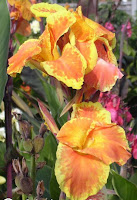
Where I started to laugh was when the article asserted that Messrs J.C. Vaughan, the distinguished Chicago seeds men then renamed C. “Tarrytown” to C. “Florence Vaughan”, and at the same time the article transformed the cultivar into being “lemon yellow with creamy-orange splotches and dots”. All the contemporary reports and Vaughan’s own adverts from the 1890's show C. “Florence Vaughan” to be a Crozy Group flower, yellow with red spots, a fully attested specimen is still grown in Australia, see below right. This total made-up version of history is quite remarkable and amusing, but there is the danger that the uninformed will take it seriously.


A study of contemporary literature would clearly show that the lemon yellow with creamy-orange splotches and blobs being referred to is C. ‘Roma’, introduced by Carl Sprenger in 1897, above left. References include Revue Horticole in France, Garden and Forest in USA, and the Royal Horticultural Society Yearbook in England. The ultimate authorities of the time, and there are many more references from unimpeachable sources, versus this silliness on the TyTy web site!
The article also goes on to assert that the Italian Royal family, King Emmanuel II and his son, King Humbert were Canna hybridisers! There is not a shred of evidence to confirm this silliness.
Also, an English gardener, presumably hinting at the award winning gardening author Ian Cooke, renamed C. ‘Yellow King Humbert’ as C. ‘Richard Wallace’. C. 'Richard Wallace' is a Crozy Group cultivar introduced by Wilhelm Pfitzer in 1906, and what is now being sold under that name is C. ‘Austria’, a totally different style, an Italian Group cultivar. It is a confirmed fact that C. ‘Yellow King Humbert’ is a mutation of C. ‘King Humbert’ (‘Roi Humbert’), and it has been sold under that name since the 1920’s. It is only since the early 1980’s that there has been confusion over that one, also, C. 'Cleopatra', which first appeared in the 1960's is also a synonym of C. 'Yellow King Humbert'.
It is obvious that whoever wrote this article is very ill-informed! My suggestion would be that they take an elementary course in Canna flower types, when they would understand that there is more to Canna flowers than their colours.
There is an article on the Wikipedia that attempts to explain the various Canna types in a fully attested manner. Wikipedia does not allow statements or assertions without supporting references. See wikipedia.
Anybody wanting to see the subject of this article for themselves can view the link at:

Monday, 14 December 2009

Canna 'City of Portland'


A medium sized Crozy Group cultivar; green foliage, oval shaped, spreading habit; oval stems, coloured green; flowers are open, jasper-red (a pink) (RHS 39A) with a narrow yellow (RHS 7A) margin, staminodes are medium size, edges frilled, stamen is gold marked, petals red, fully self-cleaning; fertile both ways, not self-pollinating or true to type, capsules round; rhizomes are thick, up to 3 cm in diameter, coloured white and pink; tillering is average.


Introduced by Antoine Wintzer of The Conard & Jones Co., West Grove, PA, USA, now the Conard-Pyle Co.


Sunday, 13 December 2009

Canna 'City of Gloucester'


A medium sized Crozy Group cultivar; green and purple variegated foliage, oval shaped, maroon margin, branching habit; oval stems, coloured green + purple; flowers are self-coloured pale pink, edges irregular, labellum is pink with yellow markings, stamen is pink with yellow markings, style is yellow with touches of pink, petals light-red, fully self-cleaning; fertile both ways, not self-pollinating or true to type, capsules globose; rhizomes are thick, up to 3 cm in diameter, coloured white and pink.
Introduced by Martin Davis, Gloucester, England, EU. Synonym: C. 'Cog'

Saturday, 12 December 2009

Canna 'China Doll'


A small Crozy Group cultivar; green foliage, oval shaped, spreading habit; oval stems, coloured green; flowers are reflexed, self-coloured pink, throat pink, staminodes are medium size, edges regular, labellum is pink, stamen is pink, petals purple with farina, fully self-cleaning; fertile both ways, not self-pollinating or true to type, capsules globose; rhizomes are thick, up to 3 cm in diameter, coloured white; tillering is prolific.

Introduced by Kent Kelly, Quality Gladiolus, Arkansas, USA.


Friday, 11 December 2009

Canna 'Childsii'


A small Crozy Group cultivar; light green foliage, oval shaped, branching habit; spikes of flowers are open, yellow with crimson blotches, staminodes are medium size, edges regular, petals red, fully self-cleaning, outstanding bloomer; fertile both ways, not self-pollinating or true to type; rhizomes are thick, up to 3 cm in diameter, coloured white and pink; tillering is average.

Introduced by Childs Nursery in 1895, and originally marketed as "The Tiger Canna".


Thursday, 10 December 2009

Canna 'Chesapeake'


A medium sized Conservatory Group Cultivar; green foliage, oval shaped, branching habit; oval stems, coloured green; panicles of flowers are open, self-coloured cream, staminodes are large, edges regular, petals yellow, fully self-cleaning; fertile both ways, not self-pollinating or true to type, capsules globose; rhizomes are thick, up to 3 cm in diameter, coloured white; tillering is average.
Introduced by R.J. Armstrong, of Longwood Gardens, USA.

Wednesday, 9 December 2009

Canna 'Cherry Red'


A medium sized Crozy Group cultivar; green foliage, oval shaped, branching habit; spikes of flowers are open, self-coloured cherry-red, staminodes are medium size, edges irregular, labellum is cherry-red, petals red with farina, fully self-cleaning, good bloomer; fertile both ways, not self-pollinating or true to type, capsules globose; rhizomes are thick, up to 3 cm in diameter, coloured purple; tillering is average.
Introduced by W. Pfitzer, Stadt Felbach, Stuttgart, Germany, EU. The old family nursery of Wilhelm Pfitzer, established in the 1840's, did not use it's name as a prefix when naming it's cultivars, this appears to be a marketing ploy by some nurseries in the USA, where the respected name of Pfitzer added prestige to the humble name given by the originators.
Synonyms: C. 'Pfitzer’s Cherry Red'

Tuesday, 8 December 2009

Canna 'Chaumes'


A medium sized Premier Group cultivar; green foliage, oval shaped, spreading habit; oval stems, coloured green; flowers are open, self-coloured yellow, throat yellow, staminodes are medium size, edges irregular, labellum is yellow, stamen is yellow, style is yellow, petals green, fully self-cleaning, average bloomer; fertile both ways, not self-pollinating or true to type, capsules globose; rhizomes are thick, up to 3 cm in diameter, coloured white.

Introduced by Pierre Turc in 2002, registered as TURcacha.

Monday, 7 December 2009

Canna 'Chatei Grandis'


A giant Foliage Group cultivar; purple foliage, very large, broadly oblong shaped, upright habit; oval stems, coloured purple; flowers are erect, self-coloured scarlet, staminodes are long and narrow, edges regular, petals purple with farina, low bloomer; fertile both ways, not true to type, self-pollinating, capsules globose; rhizomes are thick, up to 7 cm in diameter, coloured purple; tillering is prolific.

Introduced by E. Chaté et fils, route de Charenton, 143, Berey, France, EU. in 1862.


Sunday, 6 December 2009

Canna 'Charming'


A medium sized Crozy Group cultivar; green and purple variegated foliage, large, oblong shaped, maroon margin, branching habit; flowers are open, gold with a deep-pink blush, staminodes are large, edges irregular, petals red, fully self-cleaning, outstanding bloomer; fertile both ways, not self-pollinating or true to type, capsules globose; rhizomes are thick, up to 3 cm in diameter, coloured white and purple; tillering is average. 
Introduced by Malcolm Dalebö, Claines Canna Collection, Worcester, England, EU in 2008. The breeding is C. 'J.D. Cabos' x open.


This one has to be seen to be believed, the photograph was taken on 5th November 2007, it had been flowering continuously since June. It took us all our time to keep it fed, watered and groomed. Only grow this one if you are prepared to enter servitude for five months of continuous flowering!

Saturday, 5 December 2009

Canna 'Champion'


A medium sized Crozy Group cultivar; green and purple variegated foliage, oval-acuminate shaped, branching habit; oval stems, coloured purple; spikes of flowers are open, salmon and rose-red, throat gold markings, staminodes are medium size, edges irregular, labellum is gold, fully self-cleaning, average bloomer; fertile both ways, not self-pollinating or true to type, capsules globose; rhizomes are thick, up to 3 cm in diameter, coloured white and pink; tillering is prolific. Introduced by Ernest Turc, Angers, France, EU.

There is a previous cultivar with this name, it is a medium sized Italian Group cultivar; green foliage, oval shaped, branching habit; oval stems, coloured green; flowers are yellow with red blotches; seed is sterile, pollen is low fertile; rhizomes are thick, up to 3 cm in diameter, coloured white and pink. It featured in the 1908 RHS outdoor trials at Wisley. Also, listed in the Standardized Plant Names, 1942, and is still being grown in France, EU., so once again we have Canna naming confusion.

Friday, 4 December 2009

Canna 'Chameleon'


A medium sized Crozy Group cultivar; green foliage, oval shaped, white margin, branching habit; spikes of flowers are open, yellow heavily spotted with red, staminodes are large, edges regular, petals yellow, fully self-cleaning, good bloomer; fertile both ways, not self-pollinating or true to type, capsules globose; rhizomes are thick, up to 3 cm in diameter, coloured white and pink; tillering is prolific.

The earliest reference is the RHS Journal of 1894, and also featured in the 1908 RHS outdoor trials at Wisley. Appeared in the Standardized Plant Names of 1942. Still being grown in Austral-Asia, and now in the EU.

Synonym: C. 'Chaméléon'

Thursday, 3 December 2009

Canna 'Centurion'


A tall Crozy Group cultivar; green foliage, oval shaped, maroon margin, spreading habit; oval stems, coloured green; panicles of flowers are open, self-coloured tangerine-orange, staminodes are medium size, fully self-cleaning, low bloomer; fertile both ways, not self-pollinating or true to type, capsules globose; rhizomes are thick, up to 3 cm in diameter, coloured white.

Introduced by Ernest Turc, Angers, France, EU.

Wednesday, 2 December 2009

Canna 'Centenaire de Rozain-Bourchalat'


A medium sized Premier Group cultivar; green foliage, oval shaped, green margin, spreading habit; oval stems, coloured green; flowers are open, self-coloured cerise, staminodes are large, edges irregular, labellum is cerise with gold markings, stamen is cerise with gold markings, style is gold, petals red with farina, fully self-cleaning, average bloomer; fertile both ways, not self-pollinating or true to type, capsules globose; rhizomes are thick, up to 3 cm in diameter, coloured white; tillering is slow.
Introduced by the partnership of Messrs Rozain and Boucharlat, one of the oldest French nursery houses, to celebrate their first 100 years of trading in 1930.
The true pink colour was one of the Holy Grails for early Canna growers, and this was the first cultivar that could claim to have achieved a "true" pink colour.
Synonyms: C. 'Centenaire', C. 'Centenaire de Rozain Boucharlat', C. 'Centenaire de Rozain-Bourcharlat'

Tuesday, 1 December 2009

Canna 'Carnaval'


A medium sized cultivar; green foliage, oblong shaped, spreading habit; round stems, coloured green; flowers are open, orange with a yellow margin, staminodes are medium size, low bloomer; fertile both ways, not known if true to type, not self-pollinating, capsules round. 
Introduced by Ernest Turc, Angers, France, EU. Synonym: C. 'Prins Carnaval'
Yet again another Canna naming conflict as a specimen with the same name was introduced by Vilmorin-Andrieux in 1911; its flowers salmon-pink, tinged carmine, edged yellow, leaves green, height over 80 cm. The earliest specimen from Vilmorin-Andrieux is registered at the KAVB.